
Best Echo Sounder for River Surveying: Practical Hydrographic Survey Guide
2026-06-03
1. Quick Overview: Why Echo Sounders Power River Hydrographic Surveys
At Toknav, we know echo sounders are the primary depth-sensing tool in hydrographic surveys, especially for riverbed mapping. In this guide, we break down the latest survey-grade models.
We also discuss practical workflows for river surveying. We’ve built a detailed spec comparison table, picked the top 3 echo sounders for river use, and explained how your choice impacts survey accuracy and efficiency.
We’ve added clear links and CTAs to help you explore our USV and support services for turnkey solutions.
Professional echo sounder working for river surveying and hydrographic survey on field site
Hydrographic surveying maps underwater depths, terrain, and hidden obstacles. This ensures navigation safety and supports waterway engineering projects.
Rivers and shallow waterways present tricky challenges, including vegetation, turbidity, and shifting depths. That’s why high-frequency 200 kHz echo sounders are our go-to for precise shallow-water detection.
Integrated GPS and RTK positioning are also must-haves. They tag every depth reading with accurate geographic coordinates for reliable mapping results.
2. Key Factors to Choose an Echo Sounder for River Surveying
Picking a suitable echo sounder makes all the difference for smooth field work. Below are the core factors every river surveyor should check before making a choice.
2.1 Frequency & Signal Penetration
High-frequency systems around 200 kHz deliver sharp detail in shallow river water. Lower frequencies (24–33 kHz) cut through murky water but use wider signal beams.
Dual-frequency echo sounders combine both strengths, letting you capture clear data no matter if the river is clear or filled with sediment and turbidity.
2.2 Beam Angle
Narrow beams (3–5°) capture finer spatial details for precise river mapping. Wider beams (8–20°) cover more ground per ping but reduce detail level.
For example, our integrated echo sounder for Tboat USVs uses an 8° beam at 200 kHz, striking a perfect balance between wide coverage and clear survey data for river routes.
2.3 Depth Range
Most river surveys only require a 0–100 m depth range. Still, models supporting 200 m or deeper add great flexibility for deep river channels.
Our echo sounder covers 0.3–200 m, handling regular shallow rivers and deeper water sections without switching devices.
2.4 Accuracy & Resolution
Professional survey-grade echo sounders reach centimeter-level accuracy. Our model offers ±2 cm depth accuracy for highly reliable river data.
Most modern devices hit ±0.01 m or 0.1% of measured depth, with 10–20 Hz ping rates boosting data density for fast-flowing river environments.
2.5 Integration & Interface
Quality echo sounders support standard NMEA or Ethernet data output, like RS-232 and TCP/IP. This allows for seamless connection with GNSS receivers and survey software.
All-in-one portable units that combine echo sounder and GNSS simplify setup. They are perfect for small survey boats working along narrow river sections.
Your echo sounder selection directly impacts final bathymetry results. A precise device delivers clear maps, while poor transducer choices can cause data errors or missing terrain features.
3. Echo Sounder Spec Comparison for River Surveys
We’ve sorted mainstream river survey echo sounders into a clear table below, with specs pulled directly from official product data for your easy reference.
Main echo sounder models for river surveying and hydrographic survey specification display
TSBES (Single-beam Echosounder)
200k Hz
8°
0.5m-200m
1cm+0.1%h
Lan,RS232(Baud
rate9600-230400)
For shallow mapping and portable small-boat hydrography.
TMBES (Advanced Multibeam Echosounder)
400k Hz
8°
0.2m-150m
2cm+1ppm(RTK)
0.6m(SBAS)//1.2m(single point)
RS-232
High-resolution 3D mapping in shallow waters; multifunctional surveys from rivers to coastal areas.
SDE (Portable Dual Frequency Echo Sounder)
200k Hz & 20k Hz standard
200k Hz: 7°
20k Hz: 20°
200k Hz: 0.3m-200m
20k Hz: 0.5m-600m
200 kHz: ±1cm±0.1%D
20 kHz: ±10cm±0.1%D
(D is the depth value)
3* RS232, 1* RS485, 1 power
supply interface, 1 transducer
port and 1 LAN port
High frequency for shallow mapping & silt thickness; low frequency for rivers to deep seas.
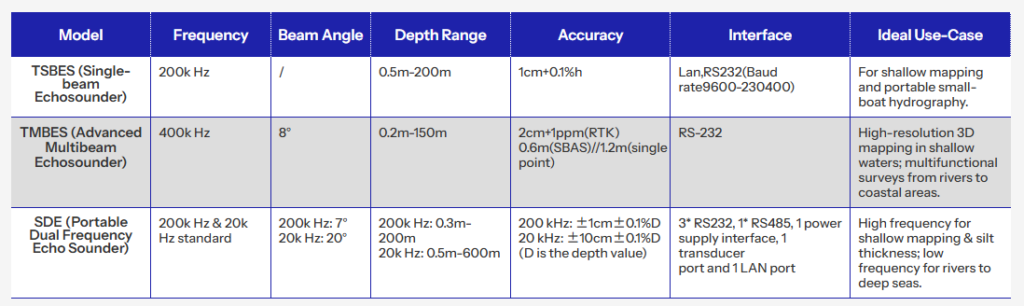
Each model has its own strengths for different river survey scenarios. Check your on-site conditions and working tools to pick the most matched solution for your team.
4. Top 3 Recommended Echo Sounders for River Survey Projects
After comparing performance, portability and field adaptability, we’ve picked 3 top models tailored for daily river hydrographic survey work.
4.1 TSBES (Single-beam Echosounder)
This single-beam sounder is built exclusively for our Tboat USVs, delivering centimeter-level precision for shallow river mapping.
Its 8° beam suits narrow river channels well. Built-in GNSS and RTK sync plus noise filters keep data stable even in turbid river water.
The plug-and-play design works perfectly with our USVs, cutting down setup time and improving overall safety during long professional survey missions.
It stands out for ultra-precise river bathymetry, letting you get detailed underwater terrain with minimal manual operation from your team.
4.2 TMBES (Advanced Multibeam Echosounder)
This portable dual-frequency echo sounder comes with built-in data logging, ideal for mobile river survey teams.
Running at 400 kHz with a 8° beam, it covers 0.2–150 m depth and maintains ±2cm (±0.1%) accuracy across full ranges.
Its compact all-in-one body fits small boats, kayaks and jet skis. Advanced DSP supports 20 Hz ping rate and clear echograms to tell river vegetation apart from real riverbeds.
Independent surveyors love this rugged device. It’s easy to deploy, records complete data and connects smoothly with external GPS units for shallow river channel mapping.
4.3 SDE (Portable Dual Frequency Echo Sounder)
This dual-channel echo sounder features a wide frequency range from 20 kHz to 200k Hz for flexible field use.
Pair it with a 200k Hz transducer for a narrow 20° beam. It supports depths from 0.3m shallow water up to 600m for multi-scene surveys.
As a trusted industry workhorse, it reaches 20k Hz ping rate and steady ±0.01 m (±0.1%) accuracy at 200k Hz.
Multiple interfaces including RS-232 and Ethernet ensure easy connection with GPS and survey software. It works reliably from narrow rivers to deep waterways.
All three models have passed real-field tests. Our USVs run stably even under strong cross-currents, while CEE devices serve river and coastal surveys worldwide.
Always follow standard workflows: finish pre-survey planning, calibrate GNSS and collect data systematically with boats or USVs for best results.
5. Standard Hydrographic Survey Workflow for River Mapping
At Toknav, we recommend following this standardized workflow to ensure consistent, high-quality river survey results. Calibrating your echo sounder properly is key to getting reliable, accurate river bathymetry data you can trust.
This workflow follows 6 essential steps, with your echo sounder playing a starring role at every stage:
Project Planning: Map survey lines and note river conditions (depth, flow, obstacles) to plan an efficient, complete route.
Equipment Setup & Calibration: Calibrate your echo sounder and RTK GNSS together to ensure depth readings tie to accurate coordinates.
Field Deployment: Use a manned boat or our Tboat USV to follow your planned route safely, even in tricky river sections.
Data Collection: Your echo sounder captures real-time depth pings, paired with GNSS positions to build detailed riverbed data.
Post-Processing & QC: Filter noise and check for inconsistencies to clean your dataset before moving to mapping.
Chart Production: Turn processed data into a clear hydrographic chart, with sharp detail thanks to high-quality echo sounder data.
6. Toknav Integrated River Survey Solutions & Final Tips
At Toknav, we deliver one-stop hydrographic packages including USVs, echo sounders and GNSS receivers to simplify your entire river survey process.
Our Tboat USVs come pre-installed with echo sounders and RTK receivers out of the box, so you can start efficient river data collection right after on-site deployment.
If you need detailed technical specs or personalized equipment configurations, browse our product pages or reach out to our team for expert guidance.
We’ll tailor the perfect USV and echo sounder combination to fit your unique river or coastal survey project demands.
Whether you handle regular river mapping, engineering surveys or long-term monitoring, our integrated solutions save your time and cut operational costs greatly.
Ready to upgrade your river survey setup with reliable autonomous equipment? Explore our full range of unmanned surface vehicles now: Click here to learn more about Toknav USVs and build your ideal survey system today.
No. 9 Caipin Road,Building B, Room 801-6, Huangpu District, Guangzhou, China
Europe | North&South America
Asia | Africa | Oceania
+86 139 2607 5986 (Jeffrey)
info@toknavgnss.com
Product
Solutions
TOKNAV is a high-end GNSS brand owned by Guangzhou Toksurvey Information Technology Co.,Ltd.
Copyright © 2025 Guangzhou TokSurvey Information Technology Co.,ltd | Privacy Policy
Become TOKNAV global distributors!
With a proven track record in surveying industry, we’re now looking for passionate distributors to join our global success story.