Avantages des 1408 canaux : performances RTK supérieures pour les systèmes GNSS multiconstellation modernes
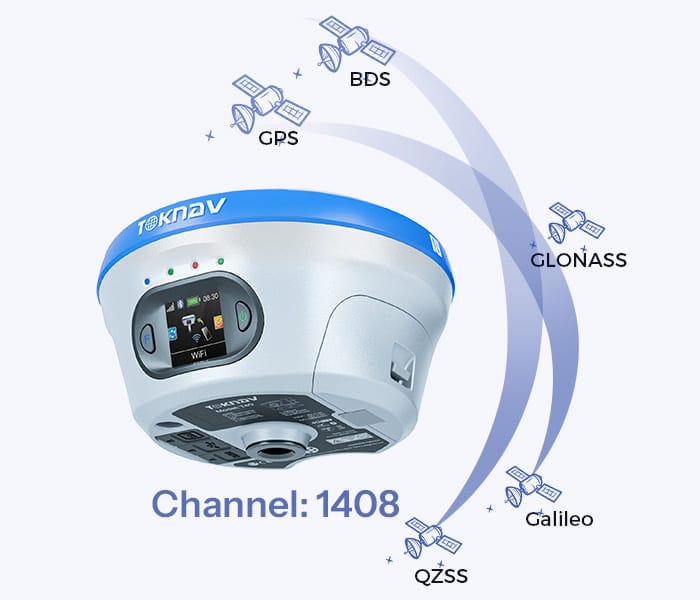
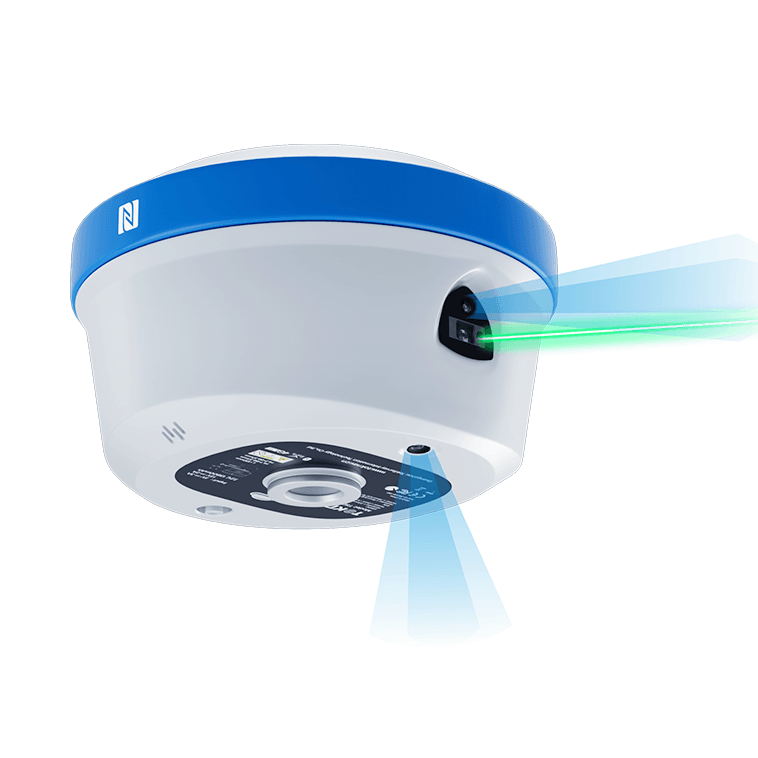
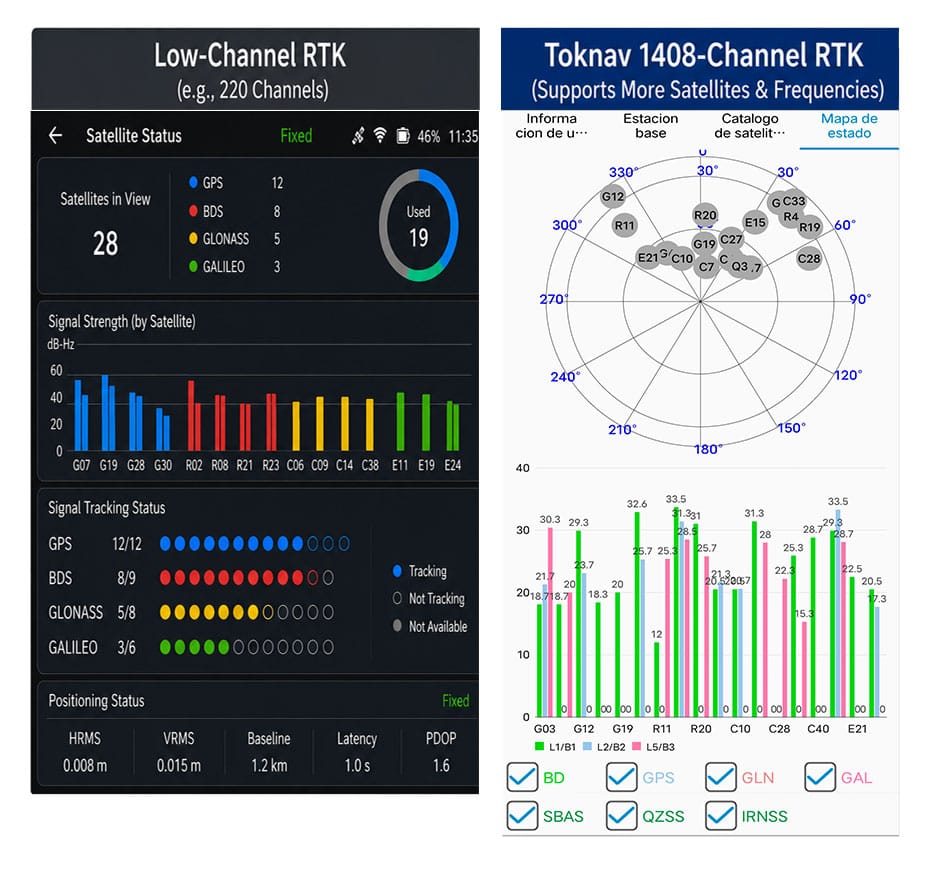
Home Benefits of 1408 Channels: Superior RTK Performance for Modern Multi-Constellation GNSS 2026-06-11 Benefits of Toknav 1408 Channels Benefits of 1408 Channels: Why Toknav’s Full RTK Lineup Leads in Multi-Constellation GNSS Positioning 1. Basic Knowledge of RTK Channel Count in GNSS Receivers 1.1 What Is an RTK Channel and Its Core Function Each RTK channel acts as an independent signal link to capture, demodulate and process satellite signals. A standard GNSS satellite transmits multiple frequency signals, and every signal requires a dedicated channel. The total RTK channel count directly decides how many satellite signals a receiver can track simultaneously in real time. RTK channel count comparison for 1400 channels GNSS and SOC RTK chip powered receivers 1.2 Drawbacks of Low-Channel Traditional RTK Devices Most old-generation RTK units only carry 100 to 600 channels. They can merely track a small number of satellites from limited constellations. In blocked areas like urban canyons or dense forests, they fail to collect enough signals, leading to slow search and frequent RTK fix loss on job sites. 1.3 How Channel Count Links to Multi-Constellation GNSS Operation Modern GNSS systems combine GPS, BeiDou, Galileo, GLONASS, QZSS and SBAS. Hundreds of satellites and diverse frequency signals operate in the air. Low-channel RTK cannot fully utilize these resources, becoming a bottleneck for high-efficiency modern positioning tasks. 2. Why 1400+ Channels Are Indispensable for Professional GNSS RTKH3: 2.1 Multi-Constellation Expansion Drives Demand for High Channel Capacity Global GNSS constellations keep expanding with new satellites and upgraded frequency signals launched each year. This clearly explains why 1400 channels GNSS has evolved from an advanced feature to a standard requirement for professional survey and positioning equipment worldwide. 2.2 1408 Channels: Full Coverage of All Mainstream GNSS Signals Toknav’s 1408 channels support full tracking of all constellations and multi-frequency signals. Unlike mid-range 800–1200 channel RTK, it never abandons weak yet valuable signals. It maximizes satellite resources to lay a foundation for stable positioning in complex scenarios. 2.3 Strong Anti-Interference and Adaptability of 1408-Channel Design Signal shielding and multipath interference are common in construction and mountainous regions. 1408 channels capture scattered satellite signals that low-channel devices miss. It optimizes satellite geometric distribution to reduce positioning errors and enhance overall reliability. 2.4 Long-Term Value: Future-Proof for Upcoming GNSS Upgradese Can Do It Satellite signal systems will continue to iterate in the next decade. A 1408-channel RTK can adapt to new satellite signals without hardware replacement. It helps users avoid repeated equipment updates and cuts long-term operating costs for engineering teams. Get 1408-Channel RTK Technical Datasheet & Quotation 3. Toknav’s SOC RTK Chip: The Core Power Supporting 1408 Full Channels 3.1 Definition and Advantages of Toknav’s Integrated SOC RTK Chip Toknav equips all RTK products with a self-developed high-performance SOC RTK chip. This system-on-chip integrates RF front-end, baseband, navigation engine and processor into one unit, replacing bulky discrete chip groups used in traditional RTK receivers. 3.2 How SOC RTK Chip Solves Multi-Channel Data Congestion Discrete chips often suffer data delay and congestion when running hundreds of channels. Toknav’s SOC RTK chip adopts optimized circuit architecture and algorithms. It distributes signal processing tasks evenly across 1408 channels to maintain ultra-low latency operation. 3.3 Power Efficiency of SOC RTK Chip for Portable RTK Devices Handheld RTK like T5 and T5Lite requires long outdoor working hours. The low-power design of Toknav’s SOC RTK chip minimizes energy consumption during full-channel operation. Users get extended battery life without sacrificing 1408-channel performance. 3.4 High Stability of SOC RTK Chip for Long-Hour Base Station Use For tBase and NET660 series base station RTK that run 24/7, the SOC RTK chip delivers stable continuous operation. It supports long-term multi-channel signal output to rovers, ensuring consistent signal transmission for large-scale CORS networks. SOC RTK chip core component supporting 1400 channels GNSS and high RTK channel count 4. Faster Satellite Acquisition and RTK Fix: The Most Obvious Benefit of 1408 Channels 4.1 Accelerated Full Satellite Search Speed Satellite acquisition is the first step of all RTK workflows. Toknav’s 1408 channels scan signals from all constellations in parallel, instead of group-by-group scanning. Field tests prove it completes full satellite search far faster than conventional low-channel RTK receivers. 4.2 Shortened RTK Fixed Solution Convergence Time RTK fix refers to centimeter-level high-precision positioning. 1408 channels collect massive valid satellite data for positioning algorithms. Rich signal samples speed up data calculation, greatly shortening the time to obtain a stable RTK fixed solution. 4.3 Rapid Reacquisition After Temporary Signal Blockage Field environments often have sudden signal occlusion from buildings or trees. Low-channel RTK needs dozens of seconds to re-search satellites. Toknav’s 1408 channels keep connecting with backup satellites and regain RTK fix within seconds to avoid work interruption. 4.4 Performance Comparison: 1408 Channels vs Ordinary Low-Channel RTK Standard 200–500 channel RTK spends 60 to 90 seconds to finish search and fix. Toknav 1408-channel RTK only needs 20 to 35 seconds for the same process. This efficiency gap directly raises daily output for surveying and mapping teams. Field test of 1400 channels GNSS RTK with great RTK channel count and SOC RTK chip 5. Toknav Entire RTK Product Line: Every Model Equipped with 1408 GNSS Channels 5.1 Economical & Handheld Portable RTK Series All lightweight handheld RTK models adopt 1408 channels, including budget-friendly T5Lite, portable T5 and engineering-standard T10Pro. They deliver fast search and fix for land planning, rural survey and basic construction measurement tasks. 5.2 High-End Laser, AR and Photogrammetry RTK Series Mid-to-high-end models T30, T40, T50 and their Pro versions integrate laser ranging, dual cameras and AR stakeout functions. Even with extra modules, they retain complete 1408 channels, keeping core positioning speed unchanged. 5.3 Professional Base Station and CORS Dedicated RTK The professional tBase base station RTK and NET660 series for CORS system construction fully support 1408 channels. For fixed base stations, abundant channels ensure stable signal coverage for multiple rovers in large engineering projects. 5.4 Special RTK for Drones, Unmanned Vehicles and Navigation NET660i-H (positioning & orientation) and NET660i-1U (unmanned vehicles) also carry 1408 channels. In drone