

GNSS Correction Guide
VRS vs RTK Base Station: Which Correction Method Fits Your Project?
Compare VRS network RTK and local RTK base station workflows for surveying, CORS, monitoring and construction projects, with practical product paths for NET660i, NET660, tBase and GNSS antennas.
Author: TOKNAV GNSS Solution Team. Reviewed by TOKNAV Product and Field Application Team. Last updated: July 2026.
When a surveying team, construction contractor, CORS operator or system integrator plans a high-precision GNSS project, one of the first questions is simple but important: should the project use a local RTK base station or a VRS network RTK workflow?
Both methods can support centimeter-level positioning when designed and operated correctly, but they are not the same. A local RTK base station is often practical for a single jobsite or short-term project. A VRS network is better suited to wider-area correction coverage, shared rover users and long-term infrastructure.

What Is a Local RTK Base Station?
A local RTK base station is a GNSS receiver installed at a known point. It sends correction data to one or more rover receivers by radio, network connection or another supported data link. The rover uses the correction data to improve positioning accuracy for field work.
Common Applications
- Construction layout and stakeout.
- Topographic survey on a defined project site.
- Field work where public or private network RTK coverage is unavailable.
- Short-term survey projects that need local control.
- Dealer demonstration kits and training workflows.
TOKNAV Product Path
TOKNAV tBase can support base-rover workflows, while RTK rovers such as T50Pro, T40Pro, T20Pro and T10Pro can be selected according to field needs.
What Is a VRS Network RTK Workflow?
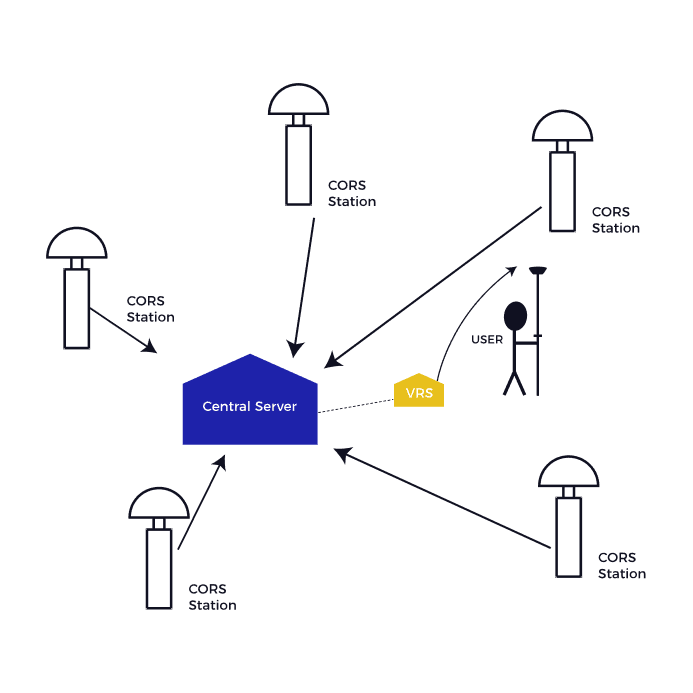
A VRS network RTK workflow uses multiple reference stations and network correction processing to support rover users across a wider planned area. Instead of relying on one local base station for one project area, the network collects data from several reference stations and provides corrections through a correction service workflow.
Best-Fit Projects
- Regional or city-level correction coverage.
- Multiple rover users working in different locations.
- Stable infrastructure for surveying, monitoring, agriculture or machine positioning.
- A correction service managed by an organization, distributor, agency or system integrator.
- Long-term operation rather than one short field job.
TOKNAV Product Path
TOKNAV Решение VRS connects CORS/reference station receivers, GNSS antennas, data communication and project planning support for this kind of infrastructure.
Quick Comparison: VRS Network RTK vs Local RTK Base
| Decision factor | Local RTK base station | VRS network RTK |
|---|---|---|
| Best fit | One jobsite, one team or short-term project area. | Wider-area correction coverage with multiple users or long-term operation. |
| Infrastructure | One base receiver, rover receivers and data link. | Multiple reference stations, antennas, communication and correction service workflow. |
| Setup complexity | Lower. Good for project teams that need fast field deployment. | Higher. Requires planning for station locations, communications, server/workflow and maintenance. |
| Scalability | Limited to local project needs and data-link condition. | Better for many rover users and larger coverage areas. |
| Typical TOKNAV products | tBase with RTK rover receivers such as T20Pro, T10Pro, T40Pro or T50Pro. | NET660, NET660i, TCA-series antennas such as TCA920 and VRS/CORS project support. |
When Should You Choose Each Method?
Choose a Local RTK Base Station When
- The project is limited to one site.
- The work period is temporary.
- Network RTK coverage is weak or unavailable.
- The team needs direct control over the correction source.
- The buyer wants a package that is easier to train and deploy.
Choose VRS or CORS Infrastructure When
- Many users need correction access across a planned region.
- The project needs long-term reference station operation.
- Correction data must be distributed by network workflows such as Ntrip.
- The solution may support surveying, monitoring, agriculture or machine control together.
- The buyer is building a correction service or infrastructure system.
Questions to Answer Before Requesting a Quote
For a Local RTK Base Station Package
- What is the application: surveying, construction, road, GIS or training?
- How large is the project area?
- Will correction data use radio, network or another link?
- How many rover receivers are needed?
- What battery, controller, software and accessory needs should be included?
For a VRS or CORS Project
- Which country or region needs coverage?
- How many reference stations are planned?
- What are the station installation environments?
- What antenna type and mounting conditions are expected?
- How will data communication, power supply and server workflow be handled?
Recommended TOKNAV Product Paths
| Project need | Recommended starting point | Next action |
|---|---|---|
| RTK surveying with local correction | tBase plus RTK rover receivers. | Request a base-rover package recommendation. |
| CORS or VRS infrastructure | NET660i, NET660 and suitable antennas. | Share station count and coverage plan. |
| Reference station antenna selection | TCA920 or another TOKNAV GNSS antenna. | Send receiver model, mounting environment and required signals. |
| Monitoring and long-term infrastructure | GNSS Deformation Monitoring with receiver and antenna planning. | Send monitoring point quantity, site condition and data interval needs. |
Next Planning Resources
After comparing VRS network RTK and a local RTK base station, use these resources to move from correction method selection to station design, antenna selection, proof review and inquiry preparation.
- CORS Station Setup Checklist
- GNSS Antenna Selection Guide
- GNSS Deformation Monitoring Guide
- TOKNAV Case Studies
- Resource Center
- Contact TOKNAV
FAQ: VRS vs RTK Base Station
Is VRS always better than a local RTK base station?
No. VRS is better for wider-area network correction coverage and many users, while a local RTK base station can be simpler and more practical for one project site or a temporary field job.
Which TOKNAV receiver should be used for CORS or VRS projects?
NET660 and NET660i are relevant starting points for CORS and reference station projects. The final choice should be confirmed by station design, data link, antenna environment and project requirements.
Which TOKNAV receiver should be used as a local base station?
tBase is a practical starting point for base-rover RTK workflows. Pair it with suitable TOKNAV rover receivers according to application, range, correction method and field environment.
Do VRS projects need special GNSS antennas?
Reference station and CORS projects usually need a suitable GNSS antenna selected by signal requirements, multipath environment, mounting condition and receiver model. TCA920 is one option for high-precision reference station applications.
Discuss a CORS, VRS or RTK Base Station Project
If you are planning a local RTK base-rover package, CORS network, VRS correction service or monitoring infrastructure, send your project details to TOKNAV. Include region, coverage area, station count, receiver preference, antenna environment, rover users and target accuracy.