SLAM-Powered LiDAR Solutions: Redefining 3D Reality Capture for Global Projects

2026-04-18

Modern global industrial and construction sectors rely fully on reliable spatial data to push digital transformation steadily forward. Every on-site engineering task, smart city planning layout and cultural heritage protection work calls for accurate, real-time three-dimensional spatial data support to solidify project foundations.
Traditional mapping tools can hardly keep pace with the fast rhythm of modern cross-regional engineering cycles and refined digital construction standards. In this critical industry transition stage, professional, scene-adaptive spatial scanning tools become the core hardware guarantee for all front-line technical teams worldwide. Reasonable deployment of efficient scanning equipment directly shortens construction cycles, cuts hidden safety risks and optimizes overall project comprehensive input costs across all links.
In today’s fast-evolving industries, digital twins, smart infrastructure, BIM, industrial inspection, and cultural heritage preservation demand high-efficiency, high-accuracy, and universally adaptable 3D reality capture.
Traditional surveying and mapping methods depend heavily on GNSS signals, suffer from low field efficiency, and struggle to perform in complex, confined, or signal-blocked environments. To address these global challenges, Toknav introduces two professional, field-proven SLAM-Powered LiDAR Solutions: the TSR20 Handheld SLAM LiDAR Scanner and the TSL150 Terrestrial Laser Scanner. Built for international users, these integrated systems combine mobility, precision, and intelligent workflow to set new standards for real world 3D reconstruction across continents, sectors, and mission-critical projects.
More field engineering teams now realize that single scanning modes can no longer cover full-site spatial collection needs of large comprehensive projects. Outdoor open road sections need fast mobile coverage to finish preliminary overall layout mapping within limited working windows. Indoor closed spaces and underground pipe corridors lack stable positioning signals, requiring equipment with independent spatial perception capabilities.
Key building components and ancient building structural nodes need ultra-fine millimeter-level point cloud data for later safety analysis and digital archiving. This multi-scenario mixed working mode puts forward higher comprehensive performance requirements for all supporting surveying hardware equipment.

SLAM Powered LiDAR Solutions: Toknav TSR20 Handheld Scanner in Field Use

Core Challenges in Global 3D Reality Capture

Global engineering survey and digital mapping work face unified practical pain points that cannot be ignored in actual on-site operation links. These common industry bottlenecks spread across urban new infrastructure, old building renovation, industrial park safety detection and remote ecological resource mapping scenarios. Many technical teams waste extra manpower and time repeatedly adjusting equipment parameters to adapt to harsh site environments. Improper equipment matching often leads to repeated data collection, delayed progress nodes and increased uncontrollable hidden costs in later data sorting links.
GNSS-denied environments including indoor facilities, underground structures, tunnels, dense urban canyons, forests, and enclosed spaces block conventional positioning systems. Conventional surveying tools completely lose effective positioning reference in such closed or sheltered areas, unable to output continuous and complete spatial coordinate data. Field staff have to manually mark auxiliary measuring points, greatly increasing on-site operation difficulty and greatly reducing overall daily working efficiency of the whole team.
Speed and accuracy are difficult to balance — mobile scanners often lack precision, while static terrestrial scanners are slow to deploy and require heavy post-processing. Many medium-sized engineering teams face awkward choices: pursuing speed means sacrificing data precision, focusing on precision means extending on-site working cycles. Back-end technicians also need to spend extra time repairing missing point clouds and calibrating offset data, raising overall technical labor costs virtually.
Complex, labor-intensive workflows extend project timelines, increase operational risks, and drive up overall costs. Disordered multi-step operation processes require multiple staff to cooperate in handover, easily causing data transmission errors and record omissions. Long outdoor working hours also raise safety risks for surveyors in high-risk areas such as steep slopes and deep foundation pits, bringing hidden troubles to project safety management.
The Toknav TSR20 and TSL150 solve these problems in tandem: mobile SLAM scanning for broad, rapid coverage and static terrestrial scanning for ultra-high-precision details. Together, they form a complete end-to-end SLAM-Powered LiDAR Solutions for professional 3D modeling and spatial data delivery. The dual-device collaborative mode perfectly fits hybrid working habits of modern front-line survey teams, realizing one-stop full-link spatial data collection from overall regional coverage to local fine capture.
Beyond hardware performance optimization, the matched supporting software system further simplifies whole-process operation logic for users. Field staff can quickly master equipment operation steps through simple standardized training, no need to learn complex professional debugging codes. Back-end data processing personnel can directly import collected original point cloud data into supporting software for one-click classification and noise reduction. The seamless connection of front and back ends greatly lowers overall technical threshold of three-dimensional reality capture work.

TSR20 Handheld SLAM LiDAR Scanner: Mobility and Real-Time Mapping Excellence

Lightweight portable scanning equipment is favored by most front-line mobile survey teams for flexible carrying and rapid deployment advantages. It can freely shuttle through narrow indoor corridors, winding underground pipe corridors and dense forest obstacle areas without limited by site terrain and space conditions. It can start data collection work in place in a few seconds, greatly saving precious on-site preparation time for engineering teams and improving daily working coverage efficiency.
Designed for dynamic, on-the-move data acquisition, the TSR20 integrates advanced SLAM algorithms with the Livox Mid-360 LiDAR sensor to generate dense, precise 3D point clouds in real time—with or without GNSS coverage. The built-in intelligent sensing chip continuously optimizes spatial trajectory calculation logic during walking scanning, ensuring stable output of high-quality point cloud data even in sudden signal interruption scenarios.

Key Advantages

Multi-Mode SLAM Performance Supporting SLAM, RTK-SLAM, and PPK-SLAM modes, the system fuses LiDAR, high-frequency IMU, and multi-constellation GNSS to deliver ≤3cm relative accuracy and ≤5cm absolute accuracy, fully satisfying professional BIM, digital twin, and engineering survey requirements. Flexible switching of multiple working modes adapts to all signal quality environments from open outdoor suburbs to fully closed underground spaces.
Unlimited Environmental Adaptability With 360° non-repetitive scanning, a 40m measurement range, and strong point penetration, the TSR20 performs reliably in underground spaces, interior rooms, stairwells, parking facilities, power line corridors, and low-canopy forests. It can resist slight dust, humid air and weak vibration interference on construction sites, maintaining stable and consistent scanning performance all day long.
Ultra-Lightweight and Ergonomic At only 1.0kg with a compact form factor, the scanner allows comfortable, all-day handheld operation by a single user. Its rugged design and low power consumption ensure stable performance in harsh field conditions. Staff will not feel arm soreness or fatigue after long-time handheld carrying, effectively improving continuous working efficiency of whole-day field tasks.
True-Color 3D Reality Dual 20MP ultra-wide cameras with 200° fields of view capture synchronized image data, producing photorealistic, textured 3D models with sharp geometric and visual detail. The restored color texture is highly consistent with real on-site scene colors, facilitating later designers to quickly identify equipment positions and wall surface abnormal signs in models.
All-in-One Workflow 64GB internal storage plus 128GB expandable SD card, wireless WiFi data transfer, and dedicated post-processing software enable seamless acquisition, visualization, classification, filtering, and modeling in one unified pipeline. Data can be wirelessly synchronized to office computers in real time after on-site collection, no need for complicated offline data copy steps.

Ideal Applications

Underground space mapping, indoor 3D reconstruction, building surveying, power line inspection, forestry mapping, emergency response mapping, and large-area mobile survey projects. It can also support rapid spatial data collection tasks in temporary emergency rescue site layout and sudden disaster area environmental assessment work, providing timely data support for emergency decision-making.

TSL150 Terrestrial Laser Scanner: Millimeter-Precision Static Scanning

In key engineering links requiring long-term structural safety monitoring and permanent digital file archiving, millimeter-level high-precision static scanning data is indispensable core basic material. Slight structural deformation and component gap deviation need ultra-high-density point cloud data to be accurately captured and recorded. High-precision static scanning equipment acts as a reliable data guardian for whole life cycle safety assessment of buildings and cultural relics.
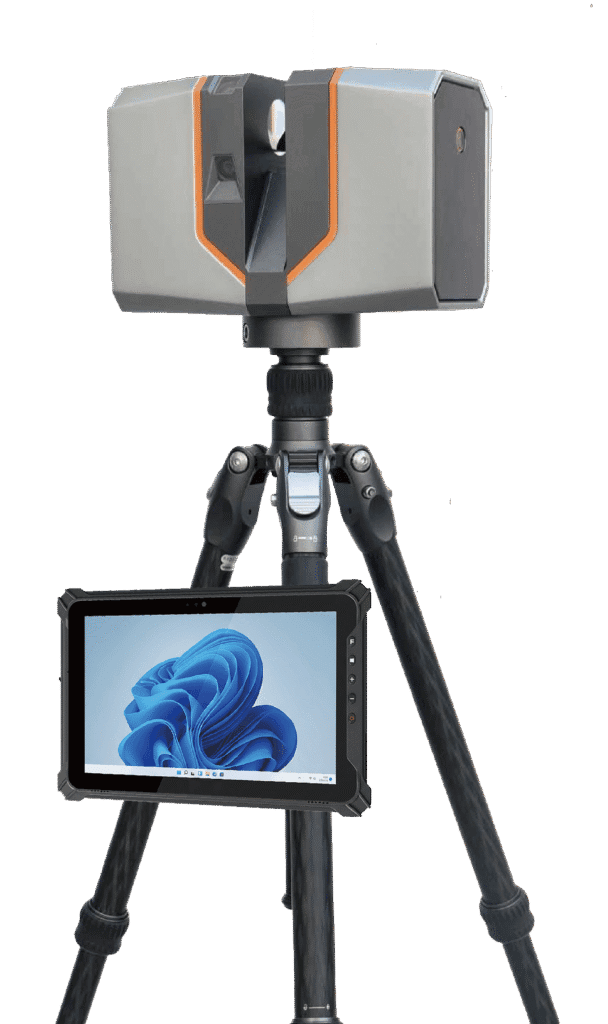
Engineered for high-precision static measurement, the TSL150 combines long-range laser ranging, professional HDR imaging, and on-board intelligent processing to deliver survey-grade results for demanding engineering and documentation tasks. The internal core measuring components undergo strict factory calibration to ensure each batch of equipment maintains consistent high-precision output performance without deviation.

Key Advantages

Millimeter-Level Accuracy With a maximum range of 150m, the system achieves 2mm accuracy@50m and 3mm accuracy@100m, making it ideal for structural monitoring, heritage digitization, precise BIM reverse engineering, and industrial metrology. Tiny structural displacement changes can be clearly reflected in point cloud data, providing objective basis for later safety hazard judgment.
High-Speed Data Capture A 1.2MHz pulse repetition rate and 100 lines/sec scanning speed drastically reduce field time while producing dense, high-quality point clouds. Compared with traditional old-fashioned static scanners, it saves nearly half of on-site fixed-point waiting time, accelerating overall project data collection progress.
On-Site Intelligent Processing Built-in software supports real-time point cloud registration, automatic multi-station adjustment, and visual measurement, minimizing office post-processing and ensuring data integrity before leaving the site. On-site technicians can check data completeness on the spot, avoiding return rework caused by missing data after returning to the office.
Compact and Flexible Deployment Weighing just 3.3kg with a small footprint, the TSL150 supports both upright and inverted mounting for use in confined spaces, elevated positions, and challenging access areas. Its IP54 rating ensures durability in tough environments such as rainy days, dusty construction sites and humid underground workshops.
Multi-Sensor Fusion A 100MP HDR panoramic camera, MEMS IMU, and multi-GNSS support deliver precisely georeferenced, color-rich point clouds ready for professional mapping and modeling. Multi-dimensional sensor data complement and verify each other, effectively improving overall authenticity and coordinate accuracy of final spatial data.

SLAM-Powered LiDAR Solutions: Toknav TSL150 Terrestrial Laser Scanner

Ideal Applications

Cultural heritage preservation, building deformation monitoring, high-precision BIM modeling, pipeline surveying, earthwork calculation, landslide investigation, and industrial facility measurement. It is also widely used in bridge regular safety detection, factory production line spatial layout planning and large stadium infrastructure digital archiving projects.

The Ultimate Combination: TSR20 + TSL150

Single scanning equipment can hardly meet full-process all-scenario spatial data demands of large-scale cross-regional comprehensive engineering projects. Only by reasonably matching mobile rapid scanning and static high-precision fixed-point collection equipment can we form a closed-loop efficient working system. This dual-device collaborative matching mode has become a mainstream efficient configuration scheme recognized by global professional surveying teams.
For global 3D reality capture projects, the TSR20 handheld SLAM scanner and TSL150 terrestrial scanner complement each other perfectly. The two sets of equipment share the same supporting post-processing software platform, no need to switch multiple different systems for data conversion and docking. The unified data output format also facilitates unified management and centralized storage of later project spatial archives.
The TSR20 rapidly covers large, complex, or hard-to-reach areas with efficient mobile scanning. It quickly completes overall regional preliminary spatial framework construction, laying a good data foundation for subsequent refined local scanning work. It greatly shortens the overall on-site data collection cycle of large-area regional survey tasks.
The TSL150 delivers millimeter-level detail for critical structures, key components, and high-precision documentation. It focuses on core load-bearing nodes, ancient building carved components and precision industrial equipment surfaces to capture ultra-fine data, ensuring key parts data fully meets engineering acceptance standards.
Combined, they provide full-coverage, high-accuracy 3D modeling with significantly reduced time, labor, and cost. Enterprises can reasonably allocate human resources, reduce redundant post-processing technical posts, and effectively control overall project operation and management costs within a reasonable budget range.
This powerful pairing supports digital construction, smart infrastructure, industrial digital transformation, and heritage conservation projects worldwide. It helps all walks of life steadily promote digital upgrading work and improves the overall refined management level of global spatial informatization construction.

SLAM-Powered LiDAR Solutions: TSR20 & TSL150 Combined Workflow

Why Choose Toknav?

In the fiercely competitive global surveying equipment market, comprehensive strength of brand technology, product stability and after-sales service system are core factors for engineering teams to select long-term cooperative suppliers. Toknav always adheres to user actual demand-oriented product research and development concept, polishing every hardware detail and optimizing every software operation logic with rigorous standards.
Professional SLAM and sensor fusion algorithms ensure stable, high-precision performance in diverse environments. The technical team iterates and upgrades core algorithms all year round, continuously optimizing environmental anti-interference ability of equipment to adapt to more complex extreme working scenarios around the world.
Global design supports multi-GNSS compatibility and operates reliably across different climate and field conditions. Whether it is high-temperature and dry desert areas or rainy and humid coastal zones, equipment can maintain consistent excellent working state without performance attenuation.
End-to-end workflow integrates acquisition, processing, and modeling to reduce complexity and improve efficiency. The simple and smooth whole-process operation logic lowers the threshold for new employees to get started quickly, helping teams shorten equipment adaptation cycle and improve overall work efficiency.
Rugged, portable hardware is built for daily professional use in international field projects. Strict high and low temperature alternating tests, drop vibration tests and dustproof and waterproof tests are conducted before leaving the factory to ensure equipment durability.
Global customer support ensures smooth deployment, training, and long-term reliability. Professional localized after-sales teams provide door-to-door equipment debugging, on-site operation training and regular equipment maintenance services for users in various regions.

Explore Toknav 3D Reality Capture Solutions

All engineering survey and digital construction enterprises pursuing efficient, accurate and low-cost spatial data collection can pay close attention to Toknav’s full range of three-dimensional reality capture supporting equipment. Professional pre-sales technical teams can provide targeted equipment matching schemes according to actual project scale, scene type and precision demands for free.
Discover how the TSR20 and TSL150 can improve accuracy, speed, and efficiency for your projects. Search keywords: Toknav TSR20, Toknav TSL150, handheld SLAM LiDAR, terrestrial laser scanner, 3D reality capture, SLAM scanning system. Users can search official keywords to view real on-site operation cases and detailed parameter comparison data of the two devices.
Toknav provides professional, reliable, and future-ready SLAM-Powered LiDAR Solutions to turn physical spaces into precise, usable digital assets. We keep innovating core sensing and positioning technologies to empower global spatial digital construction and help every project team complete high-quality three-dimensional reality capture tasks efficiently.

Become TOKNAV global distributors!

With a proven track record in surveying industry, we’re now looking for passionate distributors to join our global success story.